

Prosper Australia
Speculative vacancies in Australia and Portland
This week we launched our latest major research report, Speculative Vacancies 11: A window onto the economics of waiting.
This report examines the extent of unoccupied housing in Melbourne and what that reveals about land and housing markets.
It found that over 27,000 homes in metropolitan Melbourne, or 1.5% of all dwellings, were left entirely empty for the entire year of 2023. With the inclusion of under-used homes recording less than a quarter of the average single-person consumption over the year, a total of almost 100,000 homes, or one in 20 dwellings across the city, were vacant.
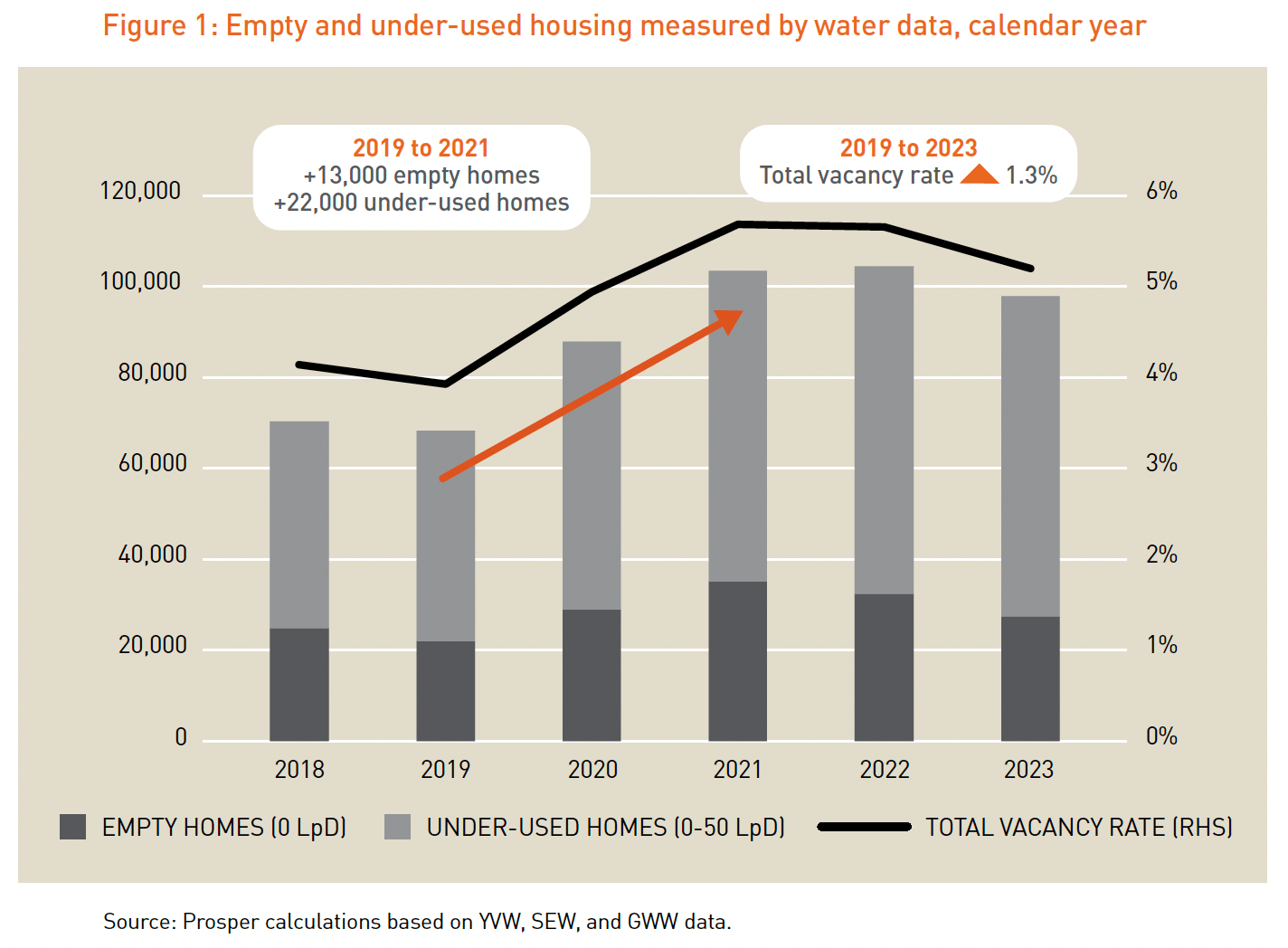
The report drew links between vacant homes and land banking, where developers delay feasible projects and set prices to slow sales in expectation of higher future returns. Both show us how housing supply is held hostage by land speculation.
This is a predictable result of a tax system that prioritises speculative asset incomes over rental yield by under-taxing capital gains and over-taxing productive activity.
When renters cannot afford to outbid the convenience value of an empty property that is a problem, first and foremost, of inequality – but we don’t need the tax system making it worse.
Vacancy taxes are a second-best solution to the problem of speculation. Prosper supports the expansion of Victoria’s vacancy tax statewide and on to vacant land, but for a more durable solution we need more effective land taxes.
Our Tax Shift vision outlines how and why we need to shift more taxation onto land and monopoly rents, using broad-based land taxes, value uplift capture, and other tools.
________________________________________________
Comment:
Just about every week Portland’s community newspaper WILLAMETTE WEEK prints an article “Chasing Ghosts” which features properties around the city that have been abandoned, are in dilapidated condition, or neglected by the owners. Here’s an example that explains what is often behind this state of affairs, in this paraphrased article:
Land Speculation in the Jade District Leaves a Gleaming Structure Empty
A nondescript gray building at Southeast 82nd Avenue and Division Street was razed a few years later, and replaced with a gleaming brick-and-glass strip mall. Despite its prime location on the corner of two major thoroughfares, the $3.5 million investment has sat empty since.
It’s located in the hub of the Jade District, which sits on one of Oregon’s most diverse census tracts and is now facing the prospect of gentrification. TriMet transit agency recently opened a brand-new express bus line down Division Street, and one down 82nd Avenue is currently being planned. A junk-filled lot next to the strip mall is slated for market-rate apartments. Half-billion dollars is expected to eventually be spent on the corridor.
All this investment has speculators salivating. Investors have grabbed up nearby underutilized and vacant properties, built gleaming new buildings, and then demanded rents that local businesses can’t afford. They are making the business decision to hold onto this property until they can command higher rents or sell at a higher price.
“It’s super frustrating,” says Duncan Hwang, a Metro councilor and director of community development at the nonprofit APANO, whose offices are in an affordable-housing complex across the street.
~
Yes, vacancy taxes are a good idea, and have been tested or implemented in cities such as Vancouver, B.C. and New York where properties are “being used to park (or launder) money by the global ultra-wealthy”. But we also agree with Prosper Australia that vacancy taxes are a second-best solution to the problem of speculation. A a more durable solution is the replacement of Oregon’s property tax system with a land value tax (LVT).
Speculative owners know that if they did improve the condition of their properties, their low property tax bills would increase under the conventional tax system. They in effect receive a tax subsidy – an inducement to speculate on land, waiting for windfall gains. LVT offers a disincentive to speculate on land. The holding of underutilized sites in redeveloping areas creates an artificial scarcity of developable land. These withheld lots can yield lucrative windfalls for owners who can wait until they can command high rents, or later resell to developers who in turn pass on the higher land costs to occupants. With LVT the capture of land value could raise holding costs to a level at which owners are induced to seek a better return on their investment by either selling their properties to developers sooner, or charging discounted rents.
Tom Gihring, Research Director
Common Ground, OR/WA