
Vox
Could this obscure tax idea reshape American housing?
Detroit may put the land-value tax to the test
By Rachel M. Cohen | @rmc031 | [email protected] Jan 5, 2024, 6:00am EST
Excerpts:
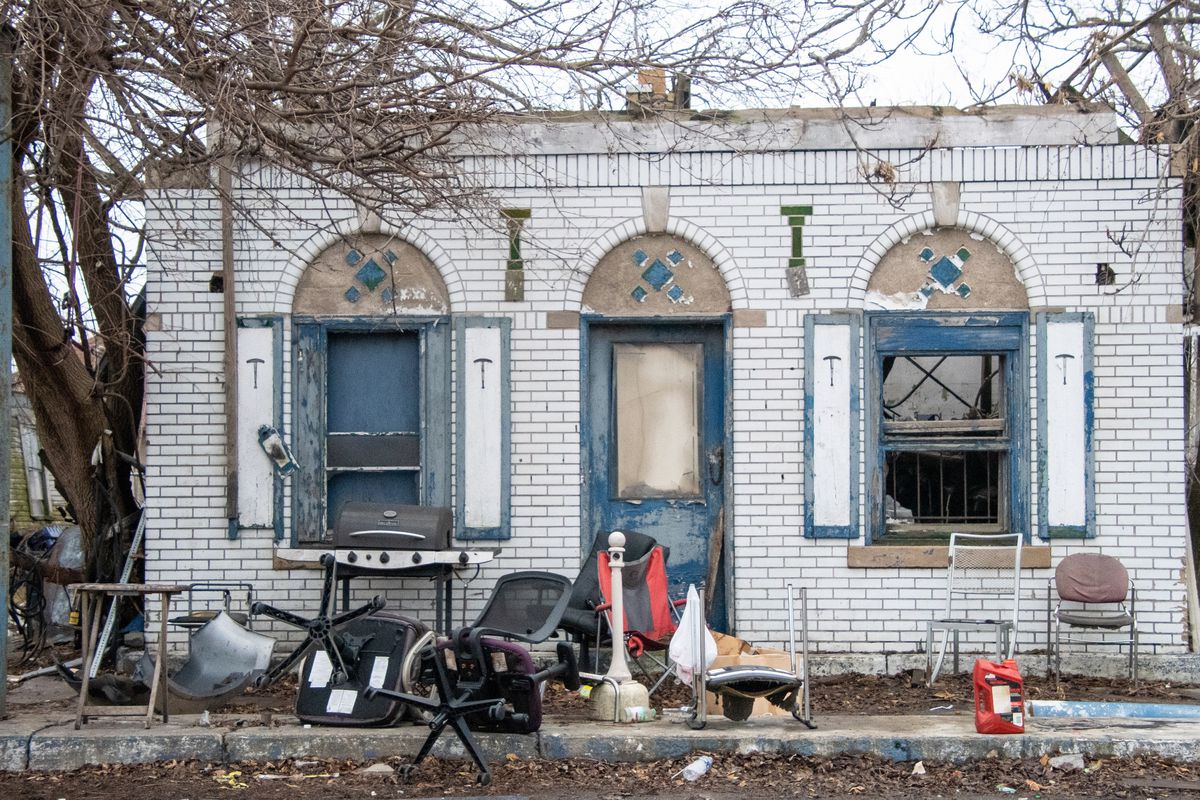
With over 50,000 vacant or abandoned homes in the City of Detroit, some houseless individuals find these buildings as a refuge in the cold winter months in Detroit. Adam J. Dewey/Anadolu Agency via Getty Images
Rachel M. Cohen is a senior reporter for Vox covering social policy. She focuses on housing, schools, labor, criminal justice, and abortion rights, and has been reporting on these issues for more than a decade.
Over the last six months, an obscure housing policy idea has emerged as one of the most talked about proposals to revive Detroit, Michigan — an idea that could potentially spur development on the city’s vast amount of vacant property as well as lower the city’s punishingly high taxes on homeowners. Economists are buzzing with interest, and the city’s mayor, Mike Duggan, is all in.
Meet the land-value tax, a form of taxation rarely tried in the United States despite being popularized globally by an American political economist in the 19th century. Versions of the tax have been implemented in countries all over the world, including Mexico, Denmark, Singapore, Russia, and Taiwan.
For nearly all of US history, American property taxes have taken a pretty standard form. Individuals pay a tax based on the assessed value of their land, buildings, and any other improvements to their property combined. If you renovate your house and make it nicer, for example, your overall property tax could go up. The proposed land-value tax in Detroit, by contrast, would effectively tax land at a higher rate than any buildings or amenities on the property.
Mayor Duggan, who is spearheading the effort, hopes this land-value tax idea will incentivize development on blighted property as well as offer some tax relief to homeowners, who bear some of the highest rates in the country. The proposal is not about lowering taxes generally, but about increasing taxes on those who own vacant land (a big problem in the city) and decreasing future taxes on people who develop their land.
First, the Michigan legislature must pass a law permitting Detroit to levy a “split-rate” property tax at all. While a Detroit state representative introduced a bill to do just that in September, other Democratic lawmakers felt the whole thing was moving too fast.
The Duggan administration still hopes to implement the land-value tax in 2025. “Ultimately it will be the voters who decide for themselves,” John Roach, a mayoral spokesperson, told Vox.
If it passes, Detroit would become the largest American city to enact a land-value tax, a fact that could spur other communities in the US to follow suit. A land-value tax could help address the nation’s housing crisis by encouraging more housing development — like building new accessory dwelling units in backyards or brand-new multistory apartment buildings on vacant property. A land-value tax could also help other communities reverse their declining fortunes through more equitable growth. It’s a lot of ifs, but policymakers, researchers, and housing activists say the chance to test the theory has never been closer in reach.
Why now?
Property taxes have long been a critical source of local public funding in the US, making up 48 percent of local government self-sourced revenue across the country in 2021. While many communities factor the value of land into their overall property tax rate, only a handful have had taxes on land specifically.
Though the land-value tax idea is not new, it reemerged back in 2019 when a Detroit development group and a local philanthropy commissioned a study by the Cambridge-based Lincoln Institute of Land Policy to see how the idea might work in their city. The report was issued in April 2022
According to the Detroit Free Press, those who would be hit the hardest under the proposal are land speculators who own vacant lots, owners of empty and decrepit buildings, owners of scrap yards and auto salvage yards, and parking lot owners. Owners of urban farms, community gardens, and side lots would be protected. Some supporters of the land-value tax idea think the Duggan administration’s proposal doesn’t even go far enough.
Economists are in support of the idea. In November, the University of Chicago’s Kent A. Clark Center for Global Markets published a poll of 41 leading economists around the world, including four Nobel laureates, and 83 percent of those who responded agreed or strongly agreed that the land-value tax would boost Detroit’s local growth over the next decade. Fifty-three percent agreed or strongly agreed that Detroit’s proposal would enhance incentives for owners to develop land.
Advocates point to the experience in Pittsburgh as the strongest evidence in the US that this is worth trying. Pennsylvania broadly has the longest history of implementing split-rate land-value taxes with more than a dozen Pennsylvania cities and school districts having adopted it. Pittsburgh, however, which had a split-rate tax from 1913 until 2001, is the most prominent example. One study from 1997 found the land-value tax played a significant role in boosting investment in downtown Pittsburgh, and helped the city avoid tax increases overall. Other research found that split-rate taxes in Pennsylvania encouraged denser housing development and influenced business formation decisions.
Pittsburgh abandoned its split-rate tax in 2001 following a countywide reassessment that dramatically increased land values, prompting a voter backlash. Pittsburgh had failed to keep up with accurate and routine tax assessments for decades, so then when they finally did one, homeowners were not pleased to see a massive spike in their property tax liabilities.
“The policy was seen as unfair because it went up all of a sudden, and policymakers abandoned it and used the split-rate tax as a scapegoat for bad execution,” said Andrew Justus, a housing policy analyst at the Niskanen Center. “Pittsburgh’s experience shows the importance of administrative competence in implementing good ideas.”
Given the experience in Pittsburgh and other Pennsylvania municipalities, few think a land-value tax will be some sort of silver bullet for Detroit. Yet most experts believe it will still be ultimately a smart move for the city, and make Detroit more enticing to business, investors, and new residents.
Some Detroit activists argue that a land-value tax will fail if not paired with fixing the city’s notoriously broken property assessment process, which often undervalues expensive homes and over-values less valuable ones. “Like a lot of American cities Detroit has historically struggled with accurate and frequent assessments and particularly at the low-end of the value spectrum,” said Justus, of the Niskanen Center. “I think critics have a legitimate concern that the city will need to keep up with accurate and fair assessments, but it’s not insurmountable.”
____________________________________________
Comment:
An update: Legislation sponsored by State Rep. Stephanie Young (D-Detroit), is expected to be voted on in the House of Representatives in early 2024. The next step after that would be for the Detroit City Council to approve language for the proposal to be on the November 2024 ballot.
A point of emphasis: Economists are in support of LVT. In November, the University of Chicago’s Kent A. Clark Center for Global Markets published a poll of 41 leading economists around the world. Economists at Harvard, Princeton, Yale, Stanford, Columbia, MIT, and others weighed in. A majority of those polled – including 4 Nobel Laureates – agree or strongly agree Detroit’s proposed land tax reform would give a “substantial boost” to the city’s economic growth. Fifty-three percent agreed or strongly agreed that the Detroit plan would enhance incentives for owners to develop land.
Places that have adopted LVT have experienced significant in-fill and redevelopment effects, along with other benefits. In the U.S., Pennsylvania has used this approach the most.
Harrisburg, once one of the most distressed cities in the nation, adopted this approach in 1975. The City rates land six times more than buildings. Since Harrisburg introduced the annual land value tax on all taxable land their city has jumped from bottom to the top group of American cities. Mayor Reed says: “Without, hesitation we can commend the importance and benefit of the land value tax policy. It has worked in Harrisburg and in other communities where it has existed.” Subsequently, 5,200 vacant properties were restored, and taxable businesses rose from 1,908 to 5,900. A number of smaller Pennsylvania towns adopting LVT also saw dramatic increases in building permits issued.
Pittsburgh was the largest city to adopt a split-rate tax, first adopted in 1913. Its tax structure has been studied for more than a century. Between 1913 and 2001, the ratio of the tax on land versus structures was 5.77. A widely cited study of LVT use in Pittsburgh showed that building construction there leapt ahead of other Rust Belt cities. Taxing land at a rate five times higher than on buildings compelled the owners of vacant sites to construct buildings and to move up the timing of construction.
We agree with some Detroit activists who argue that a land-value tax will fail if not paired with up-to-date and accurate property assessments. It is not uncommon for county assessors to undervalue land assessments. Many cases have been documented where expensive homes are undervalued and less expensive homes overvalued. “Like a lot of American cities Detroit has historically struggled with accurate and frequent assessments and particularly at the low-end of the value spectrum.”
The goal of Common Ground-OR/WA is a comprehensive reform of Oregon’s property tax system. We envision a local option land value tax that exempts participating counties and cities from M5 and M50 limitations, returning to the standard practice of basing the tax rate on true market value assessments, and lowering the tax rate on improvements while raising the tax rate on land. Recognizing the importance of accurate assessments to the success of LVT, we have prepared a list of best-practice assessment standards for use by the Oregon Department of Revenue Property Tax Division which has statutory oversight of all assessment and tax offices.
Tom Gihring, Research Director
Common Ground, OR/WA