

OHIO CAPITAL JOURNAL
Ohio lawmaker proposes land value tax amendment as alternative to property tax elimination
By: Nick Evans – February 26, 2026 5:00 am
Excerpts
While activists gather signatures to try to eliminate property taxes statewide in Ohio, a lawmaker is suggesting Ohio should tax the underlying land instead of the total property including improvements like homes and buildings.
Changing incentives
The proposal for new land taxing authority from Ohio state Sen. Bill Blessing, R-Colerain Twp., would only apply to local elected boards, and it’s permissive, so they don’t have to impose a land tax if they don’t want one.
His proposal, Ohio Senate Joint Resolution 7, would need supermajority support in both chambers of the General Assembly before it could go before voters.
The idea amounts to a reordering of incentives, and Blessing believes several positive developments could flow from that simple change. “Why are land value taxes superior to property taxes? Quite simply, they don’t tax development,” Blessing told an Ohio Senate committee earlier this month. “And as many of you know, if we’re going to tax improvements, we get less of them.” Because property taxes rise as you build, there’s an inherent disincentive to development, he explained. That’s why local governments add in sweeteners like tax abatements after the fact.
“A very likely outcome,” Blessing said, “is that land value taxes would bring in more money in the aggregate, while lowering tax bills for the individual and reducing housing costs due to the added supply.” Lower housing costs would mean ordinary Ohioans have greater buying power; a boon for them and for local businesses, he said.
Also, tax collection under the land value model would be comparatively simple and straightforward. Because of those features, he added, many economists favor land taxes to property taxes. Ohio economist Rob Moore helped Blessing with his proposal, and he explained there have been calls for a land tax for more than a century. “They’re more efficient (and) they’re more equitable than property taxes,” Moore said. “I think if we were starting from square one, this would be a much better way to do it.”
The Ohio Constitution allows local governments to levy ten mills (or 1%) in property taxes, but any additional property tax levy must go before the voters. Blessing wants land taxes to work differently. Rather than going to the ballot, Blessing thinks taxing authorities should be able to impose them by a simple majority vote. And instead of budgeting for that “rainy day” when voters reject a levy, Blessing thinks officials will have greater certainty that they can raise money if it’s really needed.
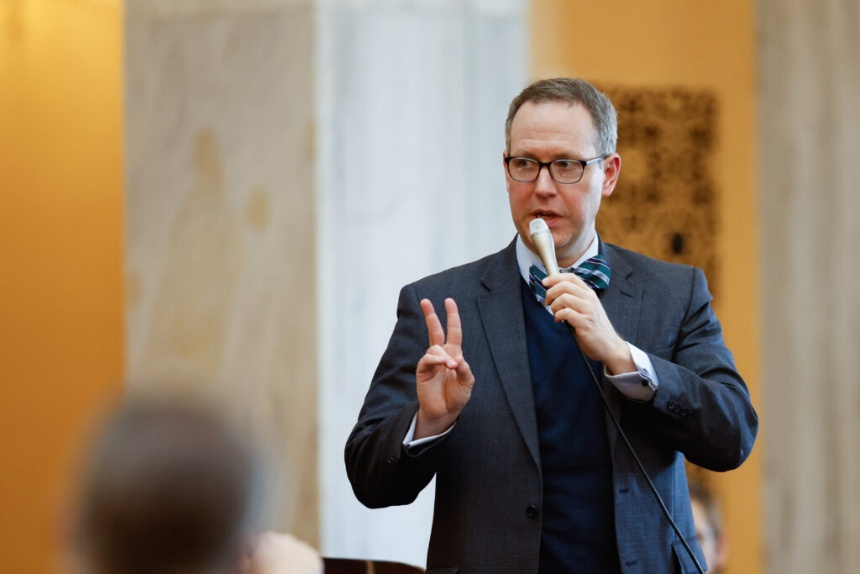
State Sen. Louis Blessing, III, R-Colerain Township. (Photo by Graham Stokes for Ohio Capital Journal.
Playing out the string
Blessing doesn’t imagine there would be some dramatic shift from property to land taxes if his proposal passed. Instead, he thinks local authorities would transition to land taxes over time as their existing property tax levies expire.
As for the amendment to ban property taxes altogether, Blessing remains skeptical it will make the ballot at all. And if it did, he thinks his land tax proposal would have a good shot against it. In short, he thinks opposition would be so vast and forceful that the abolition campaign will founder. Part of that is the well-publicized $24 billion hole it would blow in the state budget. Agencies that rely on that funding don’t want to see it threatened, and elected leaders won’t want to be blamed when other taxes shoot up to bridge the gap. Ohio’s Office of Management and Budget projects a sales tax of 15% to 18%, or an income tax of 11% to 15% would be needed to replace lost property tax revenue.
How does that work in practice?
Right now, roughly three-fifths of Ohio’s property taxes go to schools. Any change to that system could have a big impact on school balance sheets. Howard Fleeter is an economist who specializes in public finance, and he’s one of the state’s foremost experts on school funding. Most people would rather not think about property taxes at all, and frustration with the current system has led to “a full out property tax revolt,” Fleeter said. He’s not ready to fully embrace Blessing’s idea, but he’s not pushing it away either. It’s good to put every idea on the table, Fleeter explained, if Ohio voters might be considering whether to abolish property taxes in just a couple of months. “I think the points he’s making are valid points,” he said. “My bottom line on it, is the things that he’s saying and the problems he’s trying to solve, these are the right issues,” he said. “So any policy discussion of those issues, I think, is a step in the right direction.”
Warren County Auditor Matt Nolan recently served on Gov. Mike DeWine’s property tax working group. Like Fleeter, he sees a lot to like in Blessing’s idea but thinks it’s “a very long shot in the grand scheme of things.” The first hurdle he sees is the agricultural lobby. Blessing’s approach could put pressure on large landowners, and some of Ohio’s biggest are farmers.
Under Ohio’s current property tax structure, farms pay a much lower rate through the Current Agricultural Use Value program. A hundred acres of homes or businesses generate a lot more money than a hundred acres of corn or soybeans. But if you taxed farmland at that market value, you’d lose a lot of farms.
Nolan raised another potential bit of friction that could crop up between neighbors. Imagine a neighborhood of modest homes with equally sized parcels. What happens if a new owner knocks down the existing home and builds a much larger one in its place? “That person with the small house would pay the same amount (in) taxes as the guy with the mansion on the land,” Nolan said. “And I would think there would be some equity issues that would really cause some heartburn.”
But moving Ohio away from its reliance on voted levies? Nolan thinks that’s a great idea. Expanding the tax base by nullifying the tax abatements and exemptions that push more of the tax burden onto fewer property owners? That’s great, too.
“You know, I like the idea, all the pieces of it,” he added. “It seems like a big lift, but I think that this is a time more than ever we need to be exploring all these different ideas and try to find the system that works best.”
_______________________________________
Comment:
This news is very encouraging: replacing a broken property tax system with the most fair and efficient system available. Georgists around the country have been pushing back against efforts in states like Florida, Texas, Ohio, North Dakota, Montana, which are calling for the abolishment or evisceration of property taxes. This is a big mistake.
Property taxes are essentially a wealth tax, and if the tax rate is moved off building assessments onto land, it will be taxing the unearned increment of value of property, not the value created by owners. As Sen. Blessing asserts, LVT is an incentive tax. Unlike an equal rate tax which is a disincentive to invest in buildings, LVT incentivizes development. We applaud Senator Blessing, and hope that support of Joint Resolution 7 continues to gather support.
Despite the cautious support among Ohio legislators for the land value tax replacement, it appears to us that there are some uncertainties about implementation and effects. It should be made clear that this resolution offers LVT as a local option; it is not a statewide mandate. Another point: LVT is a split rate tax; no state has or would likely accept a 100% tax on land value and no tax on improvements. Some amount of annual land value gain will remain in the hands of owners. Should farmers and rural resource landowners be worried about rising tax burdens? Negative. Incidence studies of LVT have consistently shown that the incentive effect is robust in high value urban central locations and limited in outlying areas. One objective of LVT is to encourage infill development and prevent urban sprawl into semi-urban and rural areas. We have been looking into this issue in Oregon and Washington and have come to the conclusion that only cities would be offered the local option.
Sen. Blessing said a likely outcome of land value taxes is a reduction of housing costs, due to the added supply. Studies that we have done confirm that the incentive to invest in buildings by untaxing improvements results in lower tax levies. It follows that more houses will be built. Another outcome is increased housing affordability. Land values represent the speculative value of real estate. Therefore, a higher tax on land exerts a downward pressure on land price inflation – the biggest driver of rising housing prices. Over time, houses become more affordable.
Auditor Matt Nolan questions what might happen if a smaller home is demolished and replaced with a much larger “mansion”. Would nearby neighbors with smaller homes be paying the same amount? Mr. Nolan has a point, although one cannot place a figure on both tax levies until the ratio of land-to-improvement assessments is known on all properties within the local jurisdiction. Nevertheless, there are solutions to this potential problem. LVT will be implemented coincident with zoning regulations. In Portland, Oregon for instance, the revised zoning code limits replacement homes in single-family zones to under 2,000 sq. ft. On the other hand, duplex and tri-plex units are allowed on the same parcels, as square footage allows. Our proposal for implementation of LVT also includes hardship mitigation measures such as homestead exemptions and deferred tax payments.
Sen. Blessing notes that the inherent disincentive to development is why local governments add sweeteners like tax abatements after the fact. Tax abatements and exemptions are ultimately borne by taxpayers who after years of repeating this tire of subsidizing developers. LVT is basically revenue neutral; there is no revenue loss. The mechanics of this system involves tax shift within the adopting jurisdiction – from fully developed to vacant and underdeveloped properties.
Finally, Sen. Blessing doesn’t imagine some dramatic shift to land taxes if his proposal is passed. Instead, he thinks local authorities would transition to land taxes over time. This is necessary to avoid economic dislocation. As far as we know all current proposals in the U.S. for changing to a land value tax include a transition period. Our organization has prepared a thorough report with recommendations for transition in Oregon that is in line with proposals for LVT in Australia as well as New York and Pennsylvania.
We encourage legislators in Ohio to take a closer look at LVT by checking out the website of the Oregon / Washington chapter of Common Ground USA.
Tom Gihring, research director
Common Ground, OR/WA