

Route Fifty Connecting state and local government leaders
How One County Fixed Its Broken Property Tax System
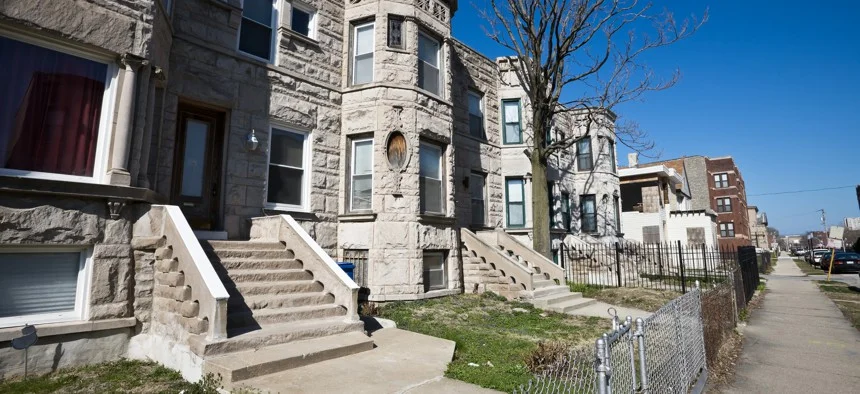
On average, reseach has found that homeowners in lower-priced homes end up paying an effective property tax rate that’s as much as 25% higher than it should be given the market value of the home | STEVEGEER VIA GETTY IMAGE
By Liz Farmer FEBRUARY 21, 2023
Property taxes are considered the ultimate “fair” tax. But that fairness hinges on the assumption that homes are being assessed accurately, regularly and thoroughly.
Excerpts:
Welcome back to Route Fifty’s Public Finance Update! I’m Liz Farmer and this week, I’m writing about why property taxes can be inequitable and what one county is doing about it.
Local governments collect roughly $500 billion per year in property taxes, which accounts for 47% of locally generated revenue and is the single-largest revenue source for cities, counties, towns and special districts.
To purists, property taxes are the ultimate “fair” tax. That’s largely because jurisdictions offer homeowners’ tax exemptions that give lower-value homes a bigger discount on their property taxes. For example, let’s say the homeowner’s tax exemption in a city is $50,000. That means that homes valued at $150,000 pay taxes on $100,000—a 33% discount off the assessed value. Homes valued at $500,000 pay taxes on $450,000 which works out to a 10% discount.
Or at least that’s how it’s supposed to work. Property taxes are a flat tax and can negatively impact low-income groups. The homeowner’s tax exemption is an effort to address this effect.
The problem is, this fairness all hinges on the assumption that homes are being assessed accurately, regularly and thoroughly. Research by the University of Chicago has shown that’s not the case. Instead, lower-value homes tend to be assessed at more than what they’re actually worth, while higher-value properties tend to be assessed at less than their market value. As a result, individuals in lower-value homes end up shouldering more of the tax burden.
“There is systematic bias in their estimates,” research author Chris Berry said recently. “These are not random errors. And it’s just pervasive throughout the United States.”
On average, homeowners in lower-priced homes end up paying an effective property tax rate that’s as much as 25% higher than it should be given the market value of the home. Property taxes are the largest cost of homeownership after the actual mortgage, so a 25% up-charge can create a significant barrier for lower-income families’ ability to purchase or stay in a home.
In real dollar figures, this amounts to billions. In Chicago, for example, between 2013 and 2017, the top 10% of homes shifted roughly $2 billion in tax bills to lower-valued homes. In New York City, that figure totaled $1 billion.
“This is real money both for an individual owner and also systemwide,” Berry said. “It’s a major wealth shift that is taking place out of the lowest-income communities.”
A Turnaround in Chicago
Even before Berry’s research, Chicagoans had evidence of a lopsided property tax system.
A study of 2018 assessments by the International Association of Assessing Officers found that commercial properties in the city were undervalued by nearly 50%. Across the county, the report found the undervaluation at almost 40%. When Cook County Assessor Fritz Kaegi took office in 2019, he began implementing a series of reforms with the goal of creating a more transparent and equitable system. His initial efforts were aimed at the gap between commercial and residential valuations and by 2021, more than $350 million in taxes shifted off homeowners onto businesses.
More recently, his office has revamped its approach to home valuations by focusing on getting more accurate micro-market data. A key factor that contributes to inaccurate assessments is that assessors base their valuations on sales averages for similar-sized homes in the general area.
But, as Kaegi outlined during a panel discussion last year, communities that are very close to each other can have very different markets and, consequently, very different housing values. For example, he said, prior valuations on the South Side of Chicago lumped in Hyde Park, where single family homes easily sell for north of $700,000, with Woodlawn, where most single family homes are selling for less than $500,000.
“So we became much more sensitive to the actual location of the home so we don’t project higher values…and that has reduced about 50% of the bias that was there before,” Kaegi said.
Berry’s research shows that Cook County in 2018 was one of the more inequitable property tax jurisdictions of any large metro area. Roughly 70% of homes are over assessed and the least expensive homes had an effective tax rate nearly twice that applied to the most expensive homes. Low-income homeowners of color were the most likely to have higher effective tax rates.
Over the last four years, Kaegi’s office hired a group of data scientists who helped develop more sophisticated modeling that makes use of machine learning. Berry’s preliminary research after the 2022 assessment cycle shows that not only did assessments become more accurate and equitable—property tax regressivity has almost entirely disappeared.
“Some of the lower priced properties were being assessed at [values] 25% or even 45% more than they were worth on the market and that’s almost entirely gone now in Cook County,” Berry said. “I was really shocked when I saw the quality of the assessments coming out. I thought it would take much longer.”
More Work to Do
There are still many more areas for improvement. Berry’s data is based on the initial reassessments and doesn’t yet include the appeals process—which wealthier homeowners are much more likely to use to their advantage to get a lower tax bill. That could result in lowering property values for the higher end of the market and inserting some regressivity back into the picture, but Berry pointed out that would at least not be due to the baseline assessment process.
There’s also the matter of home interiors, which do not currently factor into most assessments because appraisers don’t see inside homes. Kaegi said that while the county’s new modeling has improved accuracy up to a point, it still can’t tell which neighboring homes have a brand new $30,000 chef’s kitchen and which ones haven’t been updated in decades. He and other assessors are pushing the Department of Housing and Urban Development to release more data points from appraisals on federally-backed home mortgages to pinpoint those differences.
“If you can open up the [condition and] quality ratings of these houses,” he said, “that would help us reduce biases that we think are happening.”
__________________________________________
Comment:
Not all jurisdictions offer the tax exemptions Ms. Farmer describes, but the idea of giving an extra benefit to low income homeowners is worth pursuing further. First, the general property tax could be viewed as the “best tax” largely because it is a wealth tax; to some degree it captures a share of capital gain, not workers’ earnings from labor. Secondly, if you want the ‘supreme tax’ then you would need to eliminate the building portion of property from the assessment. Building value derives from the owner’s capital investment. What remains is the land portion, the value of which derives from public investments in infrastructure and public amenities. It is actually the speculative value or unearned increment. The land value tax system does this, following the principle that added value belongs to the creator of that value.
Thirdly, as Ms. Farmer states, tax fairness hinges on the assumption that homes are being assessed accurately, regularly and thoroughly. This is especially important when changing to a land-based tax, because the LVT is essentially an incentive tax: it’s designed to incentivize the best use of land and discourage land speculation. Raising the tax rate on land assessments and lowering the rate on improvements has this effect. Inaccurate assessments would distort the incentive effects.
Many jurisdictions are facing the familiar problem of property assessments over time falling short of true market value. The first step in transitioning to a land value tax is to make certain that assessments are accurate and up-to-date. If, as in Cook County, the gap between current and true assessments is huge, an immediate full introduction of real market assessments (RMV) will be a shock to many property owners. Enacting an assessment phase-in rule will gradually bring land & building values to the level needed to correct lagging assessments. We suggest a buffered phase-in, a simultaneous phase-out / phase-in yielding annual values reaching the target RMV in five years.
The next step is to phase in a split-rate LVT option over about a 10-year period. The optimal choice is to phase in both RMV and LVT simultaneously.
Finally, as for the homeowners’ tax exemptions that give lower-value homes a bigger discount on their property taxes, the “ultimate” fair tax would combine an exemption with the land tax – described as follows:
The Assessment Exemption on Improvements (AXI) is an alternative approach developed by the Center for the Study of Economics based in Philadelphia, Penn. It is designed as a land-based tax system resulting in more tax savings for smaller properties. This method employs a universal abatement on all building assessments across a jurisdiction; that is, the dollar exemption amount for buildings is the same for every parcel. Thus a $50,000 assessment exemption is much more meaningful to the owner of a modest house than to an office building or shopping center.
Applying the AXI tax to all properties within a jurisdiction would cause a reduction in total taxable values, resulting in decreased revenues. Unlike a traditional exemption, the revenue shortfall is recovered by raising the tax rate on land values. With this model, local government would not incur revenue losses. While achieving similar objectives as the LVT, mainly to provide an incentive to invest in and maintain property improvements, AXI also reduces the tax burden on lower valued properties, especially residential properties.
Tom Gihring, research director
Common Ground, OR/WA