
Prosper Australia
A TAX SHIFT FOR OUR FUTURE
For economic justice, prosperity, and the environment.
We all deserve a fair share of nature’s gifts, and fair reward for our work. We all seek a better future for ourselves, our family, and our society.
Over the last decade, we’ve watched our economy stagnate, with wages flatlining. Rising inequality within and between generations is challenging our ethos of a fair go and equal opportunity for all.
And we’re continuing to exploit the foundation of our economy and society: nature.
It can be difficult to see how we might build that better future.
The power of the tax system to reshape our economy, society and environment is underappreciated. Tax is not just about revenue, burdens, and ‘winners and losers’. It’s about collective provision, productivity, and justice.
It’s time to talk about a new basis for tax, to help Australia thrive.
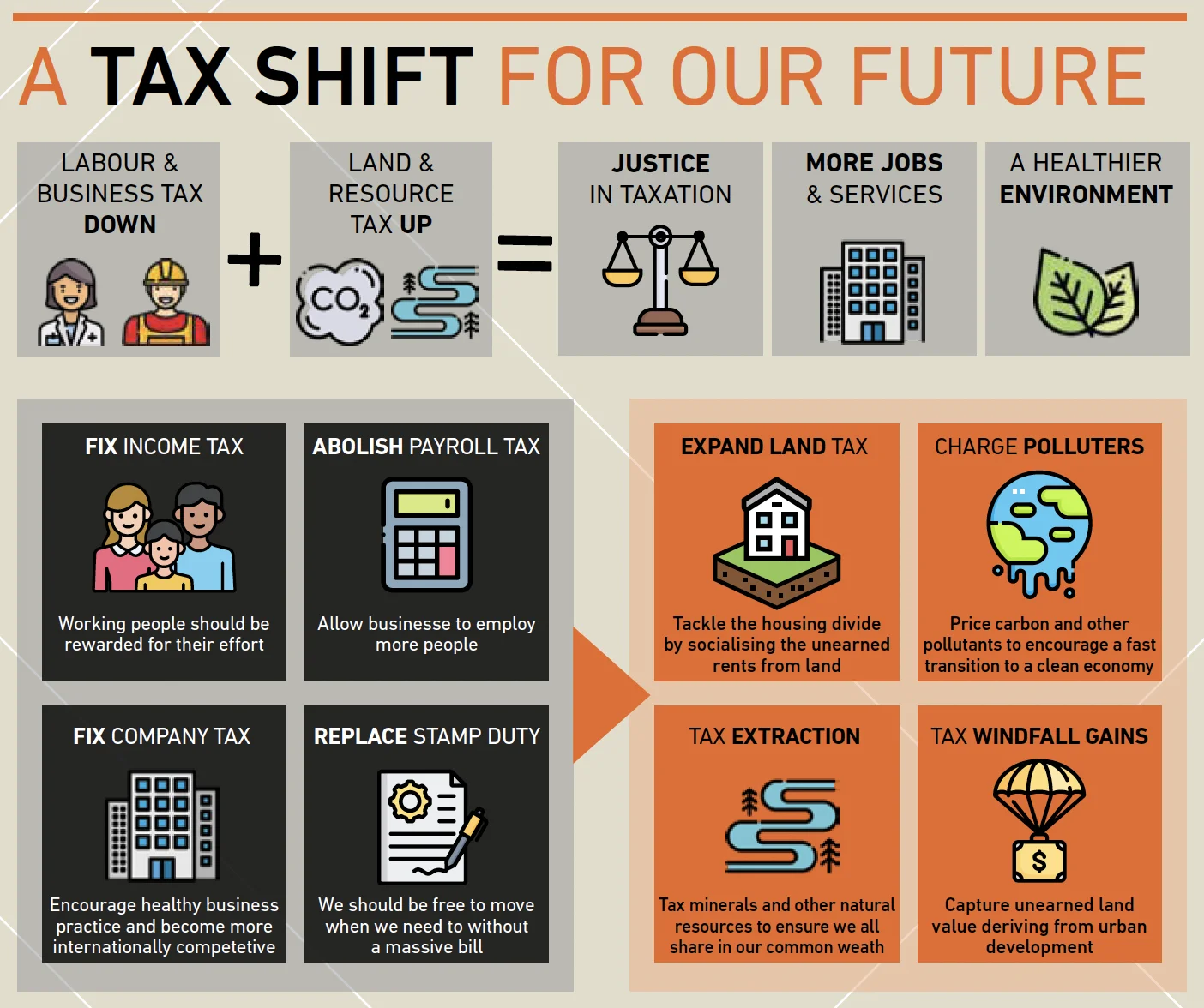
We need a tax shift – from taxes on effort, entrepreneurship and earnings to taxes on resources, rents and riches.
Hard-working Australians should keep more of the fruits of their labour, with capital income more equitably taxed. Business should be free to invest, employ and trade, but with monopolistic ‘super’ profits captured and shared.
We should tackle the housing divide by socialising the unearned rents from land, instead of granting them as reward for speculation and corruption. We should protect our environment by pricing pollution and extraction, so that none of us are taking away from the birthright of all.
There’s no single solution. We need a system change – one that realigns our taxes with our values. A bold tax shift will allow us all to prosper. We can reboot our economy and enjoy a fairer, more resilient future. It’s time to talk about the tax shift we need for Australia.
THE TAX SHIFT: AN OVERVIEW
In our new discussion paper we outline a tax reform agenda for a fairer, more prosperous and more sustainable future. The tax shift is a vision we can all understand and embrace – one that crosses political lines.
This paper is the product of a project of narrative development for tax policy research institute Prosper Australia. We hope it proves useful for other organisations across the entire policy space and political spectrum as they pursue reforms we know are rational and necessary.
The Henry Tax Review in 2010 set forth a comprehensive tax agenda for the following decade. The principles and vision behind it were widely accepted. But key reforms, including the resource superprofits tax, were undermined by opposition from powerful interest groups.
Australia has moved on – changes in the federal parliament speak to that. Once again we have a window of opportunity to work across political lines and reset our tax system for the future.
Tax reform is difficult. Everyone appreciates that tax matters, but most of us feel we know too little to take a stand. Talk of change provokes fear, and triggers strongly held views of justice.
The tax shift offers a narrative, a communication tool, which respects this challenge. It is a vision of a future towards which we can move, and a lens through which to examine specific ideas. It’s not a detailed blueprint, but a reasoned direction, grounded in an ethical view we can all support.
Lasting reform takes vision, persuasion and agreement. We think the tax shift, and the Georgist view of economic justice on which it is based, is the basis for the bipartisan change we need.
THE GEORGIST VISION OF ECONOMIC JUSTICE
Prosper’s tax philosophy is grounded in the Georgist worldview.
Over a century ago, American economist and social reformer Henry George asked the question: why do we see growing poverty despite the technological progress of the industrial revolution?
His answer came in the classic text Progress and Poverty, which became a bestseller across the world, speaking to economists and ordinary citizens alike.
For Henry George, the answer was land. The problem was exclusive private ownership of the inherent monopoly upon which all human activity takes place. Following in the footsteps of Adam Smith and John Stuart Mill, George argued that as long as landholders profit from the need of the community to access land, there can be no guarantee that economic growth will improve the condition of the poorest. A rising tide may simply lift all rents.
The crippling housing costs and stark contrast between “monstrous wealth and debasing want” that shocked George in the 19th century remain with us 150 years later. Today’s housing crisis is as old as land itself.
In modern terms, George was both an economic scientist and a policy advocate. His remedy for poverty amid progress was land tax. Not common ownership of land, but a tax paid to the community which, by its own development, produced the land value in the first place.
WHY WE NEED A TAX SHIFT
Our tax system rewards rent-seeking and punishes effort, lets some of us profit from the birthright of all, drives inequality within and between generations, and is underused as a tool for protecting the environment.
The root of the problem is that the system heavily taxes earned income from work, investment and innovation while under-taxing unearned income (economic rent) from land, resources and monopolistic advantages.
A tax shift would remove barriers to commerce, improving economic prosperity and making it easier for Australians to earn an honest living. The current system discourages productive activity and encourages rent-seeking, making us all poorer. What we tax we get less of; untaxing the productive economy would grow our collective wealth.
WHAT ARE ECONOMIC RENTS OR SUPERPROFITS?
Economic rent, supernormal profit (for a business) and unearned income (for a person) are all similar concepts. But there’s a critical difference between these forms of income, on the one hand, and normal profit (for a business) or earned income (for a person) on the other.
Earned incomes and normal profits mean getting back as good as you put in. Unearned incomes and supernormal profits reflect special, monopolisable advantages that let some people extract more from society than they contribute.

A BIPARTISAN FRAMEWORK FOR REFORM
The tax shift framework bridges the familiar political-economic divide between those calling for freer markets and those calling for more regulation and spending.
The tax shift we want is not revenue-neutral – it’s ‘revenue agnostic’. We take no stance on the overall size of government. Some will argue for a larger tax slice of the economic pie, others for a smaller one. The tax shift is compatible with both positions. It’s a reform agenda not about the size of the slice, but how the pie is cut.
The essence is that production and job creation should be relieved of tax, while economic rents should be captured for society at large.
This is inherently attractive for those prioritising economic outcomes by way of lower company, payroll and income tax. It is pro-individual and pro-business.
But it is also attractive to those seeking a fairer distribution of opportunity and more careful management of the natural world.
It’s a win-win – a bipartisan agenda for tax reform.
THE TAX SHIFT: A BREAKDOWN
Tax shift is about rebalancing the levels of different types of taxes in order to reflect their effects. Explore the sections below for more details on how the tax shift would apply to each tax type.
FIX INCOME TAX
ABOLISH PAYROLL TAX
FIX COMPANY TAX
REPLACE STAMP DUTY
BROADEN LAND TAX
TAX EXTRACTION
CHARGE POLLUTERS
CAPTURE WINDFALL GAINS
_______________________________________
Comment:
The reason for tax reform is universal: for a fairer, more prosperous and more sustainable future. The tax shift is a vision we can all understand and embrace – one that crosses political lines.
Bi-partisan support for the land value tax as a reform measure is gaining support around the U.S. as well as in Australia.