
The Urbanist
Op-Ed: The Case for Shifting to a Land Value Tax
By Aaron Schechter – June 07, 2026
Excerpts
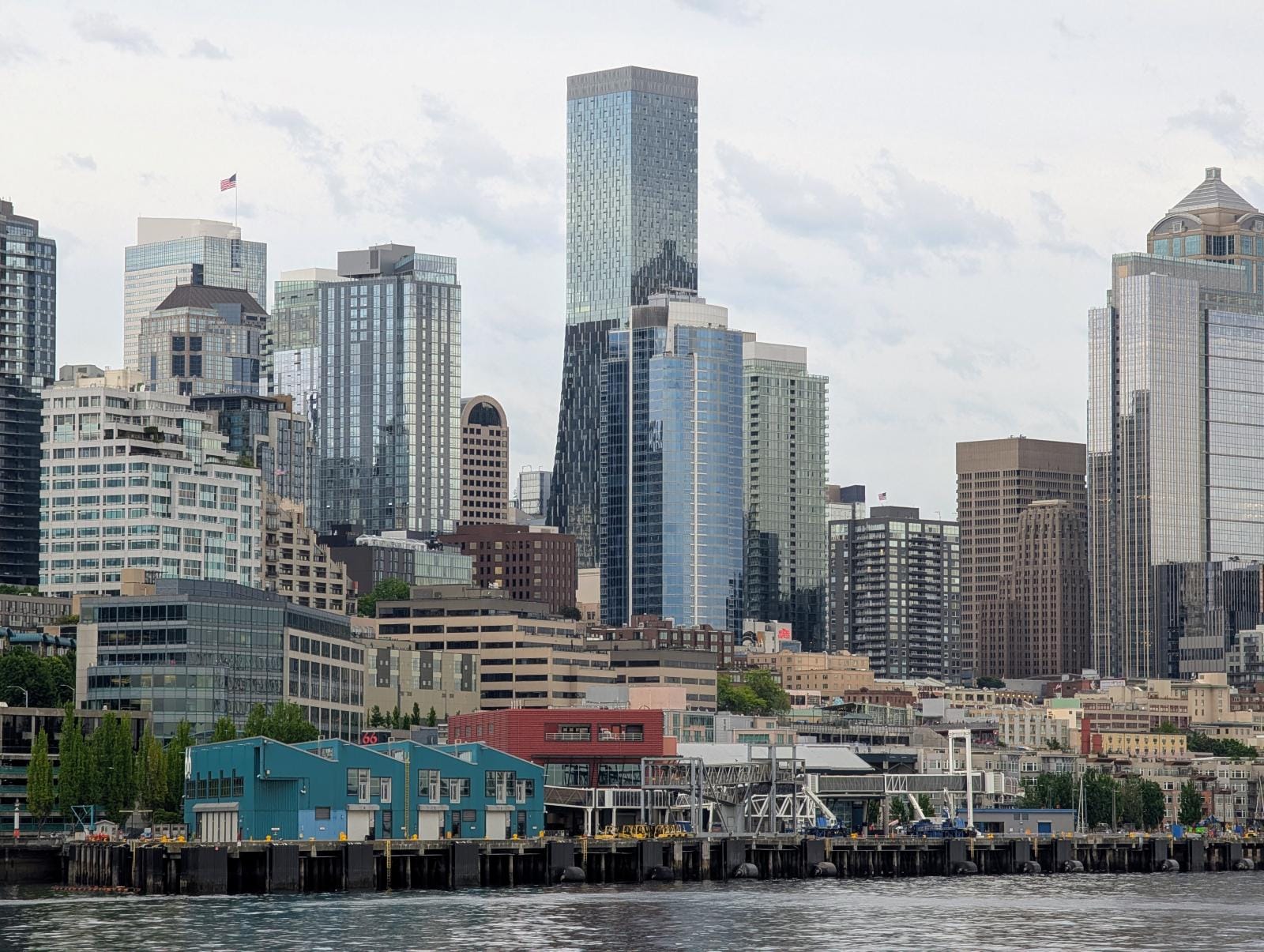
Seattle’s property tax system extracts a ton of revenue out of the downtown core, but underdeveloped properties like parking lots largely skate free. A land value tax would change that. (Doug Trumm)
Seattle’s property tax system has serious shortcomings, but adopting a land value tax could address them.
Property tax plays a critical role in how Seattle functions. In 2025, property tax represented over 22% of Seattle’s entire revenue stream, making it the City’s largest income category. Property tax brings in more than Seattle’s other significant income sources of sales tax, business and occupation (B&O) tax, and utility tax. This accounts for only about 30% of the property tax we pay, with the rest going to the County, Schools and other services. Here in the state of Washington, this revenue source is especially critical due to our lack of state income tax.
I believe that our method of assessing property tax is antiquated and unnecessarily discourages development. Current practice in King County, and essentially the entire United States, is to assess property values by combining the value of the land with the value of the improvements, unceremoniously adding them together, and then charging that year’s tax based on this sum. The improvements on the land – meaning the value of any and all structures on that land – are often assessed at dramatically higher values than the land itself.
Here in Seattle, we are blessed with being located on an isthmus. We are bound by water to the east and west and are thus unable to sprawl. This means that we have to look inward to accommodate our seemingly insatiable growth demand. Using data from 2025, the value of taxable land in the city is $126.3 billion and taxable improvements are $137.7 billion. For the rest of this piece, I will be referring to the total appraised value, both taxable and non-taxable.
Taking this to the rest of the city
Our property tax system, by nature, discourages development. When a property owner builds on their land, their tax bill jumps – often dramatically. A large taxpayer, Onni South Lake Union, located on Denny Way and Boren Avenue in South Lake Union, illustrates this well. The improvements on the lot were assessed at a hefty $714.5 million in 2022 while the land itself was valued at $49.5 million, meaning the improvements are over 14 times the value of the land. This is part of what contributes to sky-high rents in luxury apartment buildings, large additional tax burdens for every floor and unit added.
Nearly all of the parcels with the highest amounts of assessed improvements are located in the most desirable parts of the city, where people will pay top dollar to be.
I believe that our tax code should continue to tax those parcels at extremely high rates, not because their structures are so impressive, but because the land itself is so valuable. If a developer wants to build a nice 20-unit apartment in a part of town with less valuable land, I believe they should be allowed to without incurring a large tax bill derived on the quality of their building.
The effects of the current property tax system are also extremely significant in more residential parts of Seattle. Here is a small table showing the median values of some property types.
| Property Type | Median Land Value | Median Improved Value | Occurrences of this building type in Seattle |
|---|---|---|---|
| All Seattle Property | $ 477,000 | $ 422,000 | 178,565 |
| Single Family Homes | $ 497,000 | $419,000 | 130,011 |
| Townhouses | $249,000 | $450,000 | 22,360 |
| Gas Stations | $2,273,150 | $415,650 | 96 |
This table shows that there is a disparity in how different land use types take advantage of their space.
The Office of Planning and Community Development has been using the city comprehensive plan to designate ‘neighborhood centers’ across the city in an effort to encourage development. I posit that an altered property tax code, one that would not charge extremely high improvement taxes on structures built on relatively low-value land, could do a lot to help develop those types of areas.
Gas stations and the like
A huge beneficiary of the current system are businesses who operate with underdeveloped land. Gas stations pay an average of $0.23 in improved value for every $1 of land value.
For context, single family homes (which account for about 70% of our parcels) pay an average (mean) of $1.03 in improved value for every $1 of land value.
Meanwhile, townhomes, the second most common parcel type, pay an average of $1.86 in improvement value tax for every dollar of land value tax. Apartments pay an even higher ratio, at $2.14 in improved value for every $1 of land value.
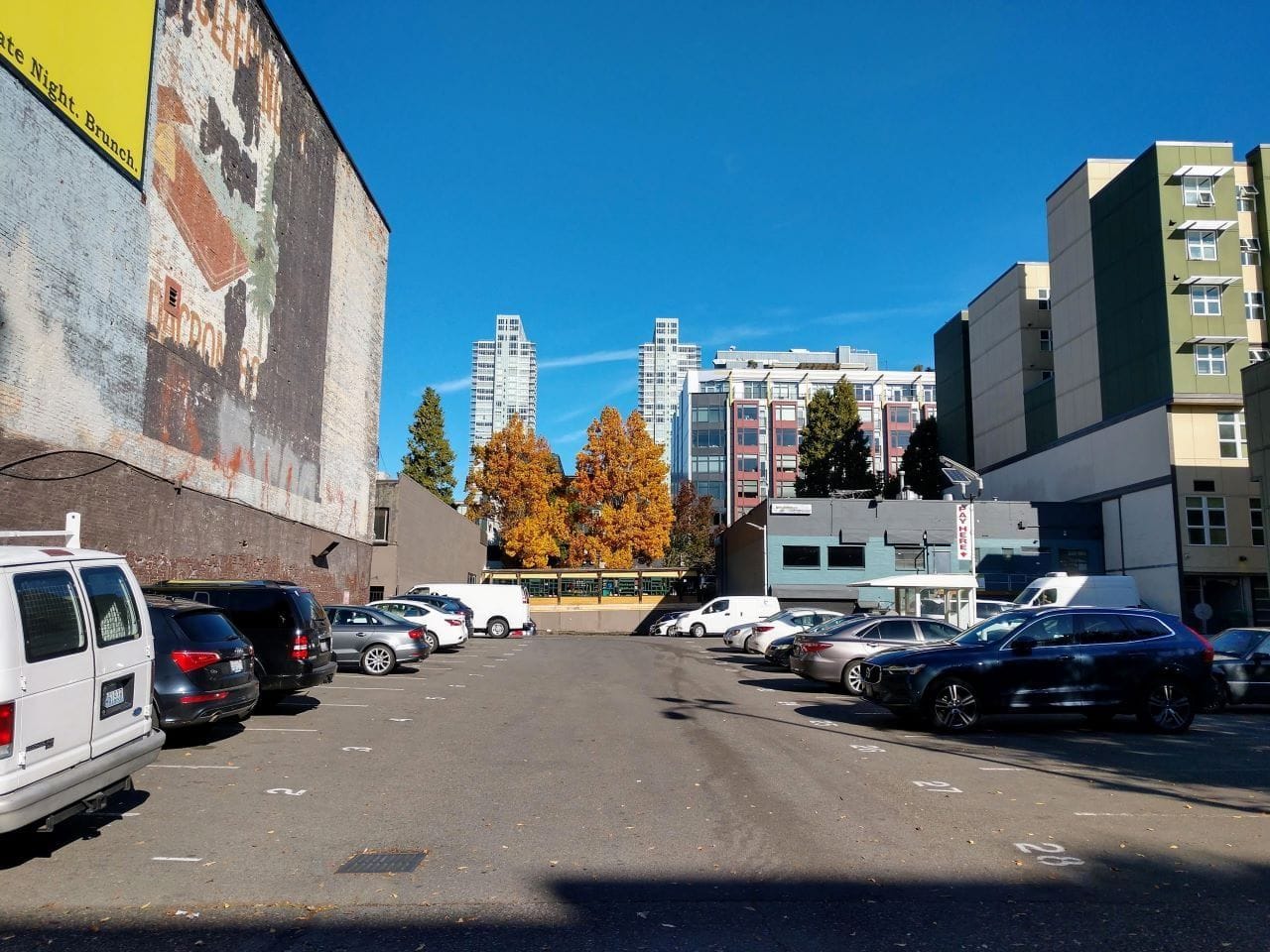 A surface parking lot in Belltown. (Doug Trumm)
These discrepancies extend to other non-maximizing land uses such as commercial parking (13 cents per dollar), big box retail (8 cents per dollar), fast food restaurants (6 cents per dollar) which all pay far less in taxes than they should just because they operate on underdeveloped land with plenty of parking. We are discouraging land use types we need more of, such as apartments and dense lots in single family neighborhoods while encouraging businesses to not maximize their land usage.
Vacant lots
This may seem self evident, but I would also like to mention vacant lots. Throughout the city there are quite a few vacant lots –specifically, there are 889 vacant single family, 253 vacant multi-family, 246 vacant commercial, and 216 vacant industrial lots. These lots naturally have extremely low improvement to land value ratios, and although some of them have valid reasons for being vacant, many of them sit empty because it is the cheapest and easiest thing to do.
If we had a system where a vacant lot had to pay the same in property tax as the identical lot next door with a house on it, chances are there would be significantly less vacancy. Our current code enables vacancy in a city that needs the opposite.
The Multi-Family Tax Exemption
How a land value tax would fit with the City’s Multi-Family Tax Exemption (MFTE) program is also worth considering. The City of Seattle created this program to generate moderate-income housing and to counteract this exact dynamic. Property developers can (and frequently do) apply for the MFTE to get a property tax exemption in exchange for providing a certain percentage of rent-restricted properties. This is a good program that makes development in our city easier.
But there are a few factors holding back the MFTE.
-
Developers still have to apply, get approved, and designate a certain amount of units to make less profit on.
-
Because it is an optional and temporary ‘exemption’, participation is erratic and it’s not geared toward a culture change.
-
It does not help a family that wants to build an accessory dwelling unit in the backyard, does not punish a business who is taking poor advantage of their land, and does not help a small developer who would want to make a multiplex on their land.
Common Concerns
I would like to address two common and valid objections that frequently get brought to this discussion.
The first being that land value tax can raise the burden on single family homeowners. For the majority of homeowners this policy change would only slightly affect their property tax bill because most homes have similar land and improved values. These homeowners would see their property tax shift marginally and gain the knowledge that making any improvement on their land would not directly lead to an increase in their tax bill. Note that considerable development in a particular neighborhood could lead to increased land values, which could drive up land value for lots in those areas.
Homeowners would now see their property taxes tied exclusively to the value of their land. Costly houses on small lots would see a tax break, whereas lots with rundown homes or lots of extra space on valuable land would see an increase. People unable to shoulder that burden would have access to exemptions.
I am not going to provide specific examples of these home types in the name of privacy, but the King County Parcel Viewer will show you many examples of both instances I mentioned.
The second commonly heard objection is that it can give significant tax breaks to the owners of the city’s most valuable buildings, which are typically highrise office or residential towers. The remedy to this is to value the land where these types of buildings are as appropriately more valuable than land on the outskirts of the city.
Here is what I mean. Consider this surface parking lot. It is across the street from Pike Place Market, some of the most valuable land in the Pacific Northwest. Meanwhile, this condo building directly behind that surface parking lot is on a parcel of close to the same size. Neighboring lots of similar size should have similar tax bills, right? In this case the parking lot pays $670 per square foot and the condo building comes in at $19,405 per square foot.
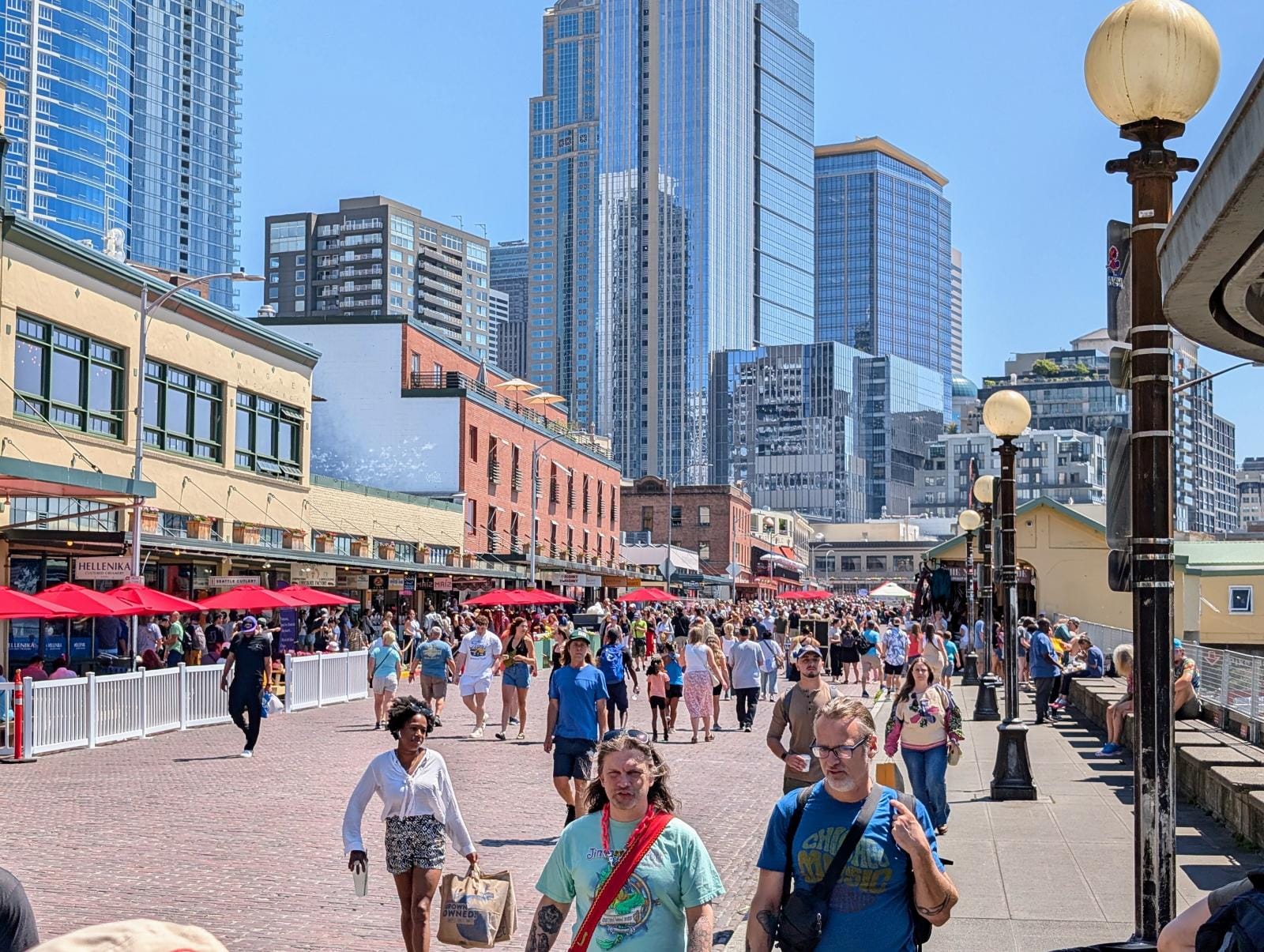 Pike Place Market borders some of the most valuable real estate in Seattle, but nearby parking lots and garages are severely undervalued in the current property tax system. (Doug Trumm)
The nearly 30x difference between these two lots illustrates one of the ways that costs for housing can get so high. Whether it be condos or apartments, the property taxes will always get passed on to the individuals, making dense housing artificially more expensive than its true cost. At the same time the discrepancy highlights the massive opportunity cost sustained by the city in allowing a parking lot to occupy some of our city’s most valuable land and getting peanuts in return.
If those two lots could have valuations in the middle, it would result in the condo residents getting serious tax relief and something far more productive existing in place of the parking lot.
As for the offices, we are in a time where Seattle’s office buildings are experiencing high vacancy rates and tenants who can easily opt for work from home models. A land value tax could make the math on the high rise office buildings pencil out a lot more easily. Buildings in high value areas such as Downtown or South Lake Union would still have considerable property tax rates due to the land value, but the ones who really take advantage of their space by building upwards would be rewarded by paying less tax per square foot.
When combined with other creative business taxes such as Seattle’s jumpstart tax, our businesses would still be paying large amounts while also having a more realistic path towards high occupancy rates. A thriving Seattle needs both high commercial and residential density.
Pros to Land Value Tax
I want to clearly summarize some of the positive effects that a land value tax can have on a region.
First and foremost a land value tax can lower rents. Our current tax code increases property tax for increased building quality and size, passing those costs directly to renters. If land parcels paid the same property tax no matter what was on them, then owners of that land could build more units without fearing higher tax bills.
Secondly, this code can be an amazing tool in encouraging missing middle housing. Higher density options in more residential neighborhoods are critical in our journey to grow. About 70% of parcels in the city are single family homes, and with recent upzoning laws passed, those parcels are now eligible to house more people. Not increasing the tax bill for those developments considerably lowers their risk and would help projects actually happen.
Thirdly, and perhaps most importantly, land value tax can stop stunting urban development. As I covered previously when talking about gas stations, parking lots and other underdeveloped land, certain parcels can skate by with a far lower property tax bill than their neighbors. This will always exist unless there is a change, acting as an enormous opportunity cost for the city and county.
What we can do about it
Tax law is notoriously difficult to change, and I am no legal scholar or politician. So take this with a grain of salt.
I propose slowly, over time, increasing the ‘weight’ of the land value and decreasing the ‘weight’ of the improvement value. In year one of implementation, we could assess properties as we normally do, but when it comes time to do that final sum to add together the land value with the improved value, the assessors office could multiply the land value by 1.02, and multiply the improved value by 0.98. And then the next year change those numbers to 1.04 and 0.96 respectively and keep it going, so that in 50 years we are charging only tax on the land.
This way, property owners wouldn’t be surprised by the changes; people would have plenty of time to adjust and pivot, and it would slowly become more and more expensive to be the owner of a lot that is doing nothing.
The changes I propose here are all intended to encourage development in a smooth and natural way, primarily by discouraging gross underuse of valuable land like surface parking/strip malls/vacancy and to encourage increases to density.
Pushing the idea forward
I know that this is a serious topic and that there are many considerations that I have either not covered in this article or have not considered myself. If you are reading this and have thoughts I would love to hear them. Please reach out at [email protected]
Thanks to King County for the data, and if you would like to see my code for this project you can find it here.
______________________________________
Comment:
Aaron begins by citing the problem with the conventional equal rate property tax. Inherent in the equal rate method is a set of incentives that many economists and a growing number of legislators find to be counterproductive. Taxing building assessments produces a financial inducement to neglect structural improvements and delay capital investments.
Land and buildings are fundamentally different. Public sector commitments, in the form of land use plans, zoning regulations, and capital investments in public amenities such as schools, libraries, fire protection and transportation infrastructure, will stimulate private sector investments in housing and new businesses. This economic activity results in the growth of “location rents,” or rising land values. Land value increases are experienced generally, that is, on all parcels with similar location attributes, independent of capital investments in building improvements that individual owners may undertake.
When local jurisdictions up-zone urban districts to accommodate more residential units or commercial floor space, the underlying land values are likely to increase. Similar effects will occur when urban growth boundaries (UGBs) are extended to accommodate urban expansion. These are regulatory actions that result in “givings” – the converse of “takings.” This unearned increment (location rent) can either be retained by individual owners as a capitalized asset or captured by the public sector to be applied to public benefits.
A basic principle in liberal economic theory holds that legitimately created value belongs to the creator of that value. Land value is created cumulatively by the community, and as such belongs to the community; building value is created by private capital, and as such, belongs to the owner. Hence, government is justified in recapturing by means of property taxation what it has “given. Land-based tax systems have been adopted in many jurisdictions around the world and have a proven track record of fairness and positive incentive effects.
Aaron continues by illustrating how low tax levies on vacant and underutilized properties are a disincentive to construct building improvements. The point not further developed in the article is that some landowners intentionally sit on valuable land waiting for surrounding land values to rise to a level where a potential windfall can be realized upon resale, then passing on the higher value of a site to the purchasing occupants. This Is plain and simple SPECULATION. One of the principal purposes of LVT is to discourage land speculation.
To cite an example, decades of population loss in Detroit left behind vast tracts of empty, unproductive parcels and abandoned lots. High property taxes shifted onto low-income residential properties fueled cycles of tax delinquency, abandonment, and tax foreclosure.
Cheap land combined with low taxes on the land itself made it easy and inexpensive for outside speculators to buy empty lots and wait idly for surrounding public investment. That’s when Mayor Mike Duggan began to argue for a land value tax.
Next in Aaron’s article is a discussion about property tax exemptions. The City of Seattle adopted a tax incentive program to encourage the development of affordable housing in targeted neighborhoods, authorized by state law (RCW 84.14). Under the Multifamily Tax Exemption Program, the improvement portion of the total property tax billing is exempted for up to ten years on building projects of four or more units. Within the Downtown Urban Center, International District and Pioneer Square were selected for a pilot test of this program. Denny Triangle was added later.
But the problem with any tax abatement scheme is that its application results in either a net revenue loss to the taxing jurisdiction or a tax shift onto all other taxable properties. Furthermore, such programs are subject to voter approval. After a while, taxpayers become weary of supporting everlasting subsidies.
A better alternative to abatement is the land value tax system that shifts tax burden in accordance with the desired effects on land utilization. A two-rate system would tax vacant and underutilized sites more heavily and fully developed sites less. The effect is to curb land speculation. My previous study of LVT effects in Seattle’s DUC found that on a typical Denny Triangle site, the average rent reduction is 6.28%, compared to 7.54% resulting from the tax exemption. * The effect on rent reduction is moderately less than the abatement scheme, but there would be no revenue loss or indiscriminate shift of tax burden. Over time the land-based tax will expand the city’s tax base by encouraging more building activity.
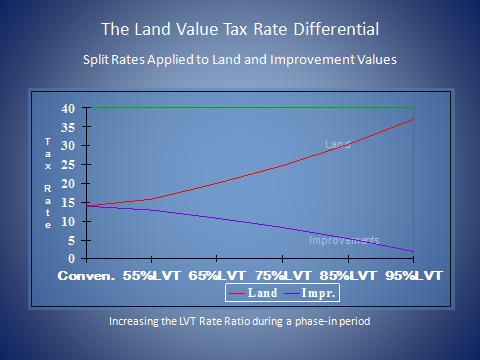
Finally, Aaron suggests slowly, over time, increasing the ‘weight’ of the land value and decreasing the ‘weight’ of the improvement value. This is a phase-in of LVT, which we in Oregon have expounded in some detail. A phase-in period allows property owners affected by higher tax burdens under LVT an opportunity to adapt over time by lowering sales price expectations or reinvesting in new building improvements. A transition period of ten years might be applied during which the land / building tax rate differential would gradually increase.
Aaron proposes a gradual phase-in over 50 years, reaching a 100% land tax. We propose a shorter period because public officials approving the local option LVT expect to see evidence of the incentive effects sooner rather than later. Also, it should be noted that no jurisdiction adopting a split-rate tax has reached a land only tax rate. Our simulation models using hypothetical split rates applied to property records start at 55 percent of the total tax rate on land assessments and gradually increase to 95 percent, as illustrated here:
* Working paper is adapted from the Technical Housing Report to the Downtown Urban Center Planning Group, Section 7: Housing Strategies – Tax Incentives, September, 1998.
In any tax shift scheme, there will be some hardship cases, especially those owners occupying low value buildings on high value sites, usually in transition areas. Because the equity criterion for property taxation is best achieved through the owner’s payment in proportion to benefits received (land rent, incorporated into ‘equity’), a broad-based tax exemption may be less suitable. Revenue losses can be avoided if the relief measure were in the form of a deferral – making the tax liability due at the point of resale when the accumulated home equity becomes sale proceeds.
Aaron Schechter makes a compelling case for the adoption of LVT in Seattle. The city would do well to follow Spokane’s lead. City Councilwoman Kitty Klitzke and other supporters are reacting to the current tax system’s built-in method to encourage land speculation. “A property tax that exempts buildings and shifts the burden onto land would give us a new and powerful tool to fill in our gaps while keeping Spokane affordable.” Mayor Katie Wilson, take notice.
Tom Gihring, research director
Common Ground, OR/WA